
Underground Mine Ventilation: What Gold Investors Should Evaluate
Underground gold mines need a dependable flow of fresh air to working areas while removing diesel exhaust, blasting fumes, heat, dust and other contaminants. Ventilation is therefore both a safety system and a production constraint. For investors, the important question is not simply whether fans are installed, but whether the complete airflow network can support the mine plan as workings deepen and equipment activity changes.
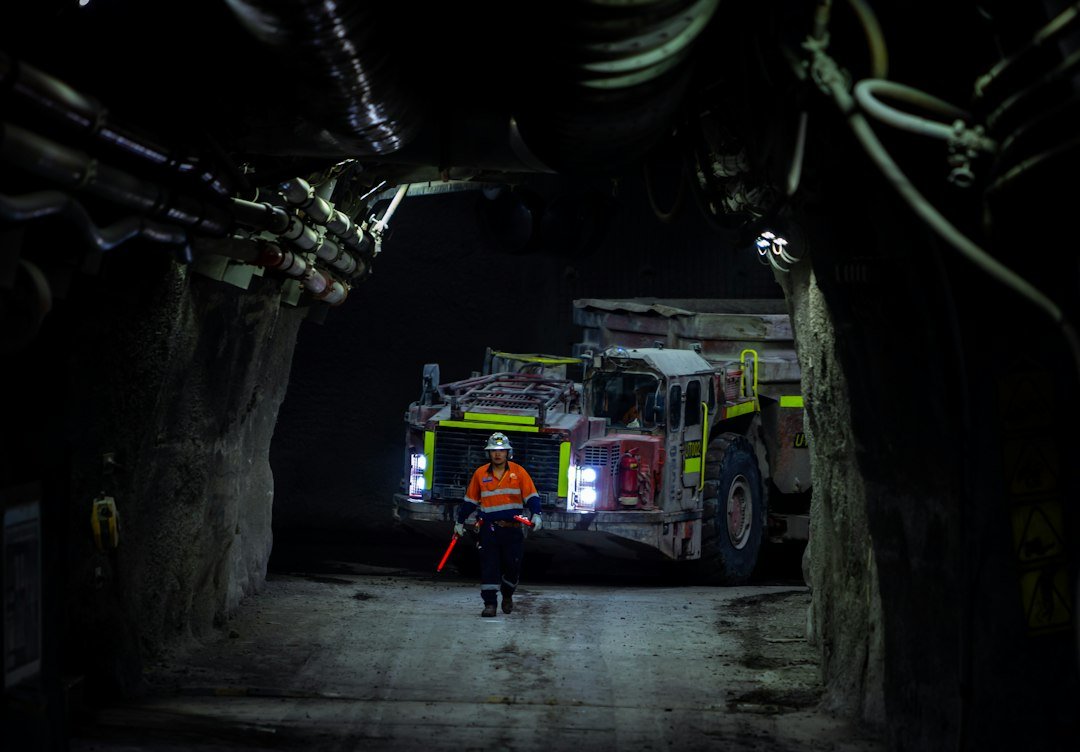
Illustrative underground-mining image; not a GBDS property or evidence of project conditions or performance. Photo by Munkh-Erdene Eenee on Unsplash.
What the Ventilation System Must Do
Primary fans move air through shafts, raises, declines and major drifts. Regulators, doors, stoppings, booster fans, auxiliary fans and ducting then direct it toward active headings and stopes. The system must account for equipment locations, worker occupancy, blasting schedules, leakage, recirculation and heat. A design quantity at the main fan does not prove that enough clean air reaches the face.
NIOSH’s guide to diesel aerosols and gases in underground mines describes ventilation as one part of an integrated exposure-control program that also includes engine maintenance, exhaust aftertreatment, fuel choices, monitoring and operating practices. That matters because more airflow alone may be costly or insufficient if ducting is damaged, contaminants recirculate or high-emitting equipment is concentrated in one ventilation district.
Current U.S. Regulatory Note
On November 12, 2026, MSHA published a final rule in the Federal Register concerning diesel particulate matter in underground metal and nonmetal mines, effective December 14, 2026. The action removes outdated interim dates and limits; it does not reduce the existing protection. The rule clarifies the continuing eight-hour full-shift limit of 160 micrograms of total carbon per cubic meter of air. This U.S. update should not be assumed to apply in other jurisdictions.
Ventilation Can Limit the Mine Plan
As a mine expands laterally or vertically, airflow routes become longer and resistance can rise. Production growth may require new raises, shafts, fans, refrigeration, electrical capacity and control infrastructure. These additions can involve long lead times and capital spending. If ventilation development lags the production schedule, access to planned stopes may be delayed even when ore is physically available.
As an external example—not a GBDS project fact—a March 2026 SEC-filed technical report for the Didipio Mine describes studies supporting a substantial future airflow increase, additional raise-bored shafts and a ventilation-on-demand system. The filing illustrates why investors should connect production forecasts with ventilation capacity, construction timing, long-lead procurement and commissioning risk.
Hypothetical Energy-Cost Example
Hypothetical example: Assume a mine’s ventilation fans average 4 megawatts of demand for 8,000 operating hours per year, and electricity costs $0.09 per kilowatt-hour. Gross annual fan energy cost would be about $2.88 million: 4,000 kW × 8,000 hours × $0.09. A validated 10% reduction in average demand would imply a gross energy difference of about $288,000 per year.
This is not a project forecast or guaranteed saving. Actual results depend on fan efficiency, tariff structure, leakage, production schedules, control-system capital, maintenance and the minimum airflow needed for safety and compliance. Energy reduction must never override required air quality or emergency capability.
Risks and Due-Diligence Questions
Investors can ask whether the life-of-mine ventilation model matches the mobile-equipment fleet and production schedule; when new openings and fans are required; whether refrigeration becomes necessary at depth; and how airflow, gases, dust, temperature and diesel particulate matter are monitored. They should also examine emergency ventilation, backup power, fan redundancy, inspection frequency and responsibility for correcting damaged ducting or controls.
Ventilation-on-demand can direct air toward occupied or active areas, but it introduces sensors, communications, automation and cybersecurity dependencies. A credible plan should include fail-safe modes, alarm response, system validation and trained personnel. The strongest investment case links ventilation performance to measured air quality, development milestones, equipment deployment, energy use and achievable production—not to headline airflow capacity alone.
Educational disclaimer: This article provides general information only and is not investment, engineering, safety, legal or tax advice. Mining investments involve operational, regulatory, commodity-price, financing and jurisdictional risks. Review current technical reports and regulations and consult qualified advisers before making an investment decision.